
Pediatric Dental Crowns in San Marcos, TX
When Does a Child’s Tooth Need Full-Coverage Protection?
A filling repairs a limited area of damage. When decay, a fracture, or a structural weakness affects more of the tooth, the remaining enamel may not be strong enough to support a filling. Pediatric dental crowns in San Marcos, TX cover the visible part of the tooth, helping it withstand chewing and remain useful as your child grows.
At Springtown Pediatric Dentistry, Dr. Christina Mueller examines how much healthy tooth remains, whether the tooth can be restored, and how long it is expected to stay in place. She recommends a crown only when full coverage offers a more dependable option than a smaller restoration.
Why Treating a Damaged Baby Tooth Matters
Baby teeth help children chew, speak clearly, and hold space for permanent teeth that are still developing. When a damaged baby tooth can be restored, a crown may allow it to stay useful until it is ready to fall out naturally. Dr. Mueller considers the tooth’s condition, your child’s age, the position of the permanent tooth, and whether the tooth can be treated predictably before recommending a crown at all.
A crown is not always the right choice. If decay or infection is too advanced, or the tooth is close to falling out, removal may be more appropriate. Dr. Mueller explains the available options and recommends the approach that best supports your child’s comfort, chewing, spacing, and dental development without placing treatment that offers little long-term value for your child.
How We Place a Pediatric Crown: Step by Step
1
Numbing and Preparing Your Child
Dr. Mueller first makes sure the tooth and surrounding area are numb. The team explains the appointment in language suited to your child’s age and gives them time to settle before treatment begins.
2
Removing Decay and Shaping the Tooth
Any decay is carefully removed and the tooth is shaped to create a clean, precise foundation that allows the crown to fit securely and function properly.
3
Selecting and Fitting the Crown
Dr. Mueller selects the crown that best matches the size and location of your child’s tooth, adjusting it chairside until the fit is just right.
4
Cementing and Checking the Bite
The crown is secured with dental cement and the bite is checked to make sure everything feels natural and comfortable before your child leaves the chair.
Meet the Pediatric Dentist Who Understands Kids

Dr. Christina A. Mueller, DDS, MPH, is a board-certified pediatric dentist and founder of Springtown Pediatric Dentistry in San Marcos. A sixth-generation Texan and second-generation pediatric dentist, she studied mathematics and biology at Southern Methodist University, competed in collegiate discus, earned public health training, and completed advanced pediatric dental education.
Her prevention-focused, relationship-centered approach considers each child’s teeth, growth, airway health, comfort, and overall well-being. As both a pediatric dentist and mother, Dr. Mueller understands parents’ trust. She creates a calm dental home where children feel safe, families feel heard, and healthy habits can begin early and last through childhood.

Signs Your Child May Need a Dental Crown
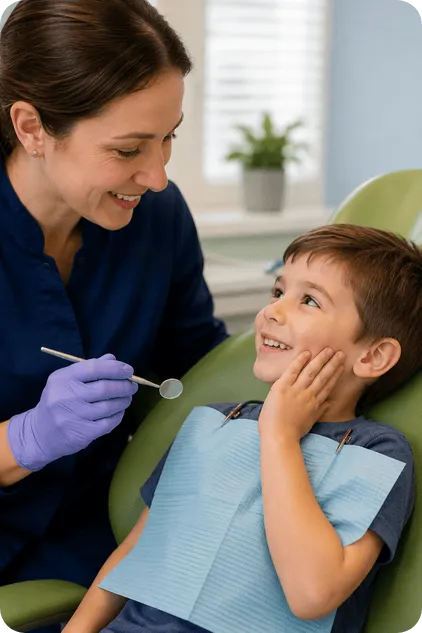
Not every cavity requires a crown, but there are certain situations where a filling is not sufficient to fully restore a tooth. If you notice any of the following, it is worth scheduling an evaluation with Dr. Mueller so she can assess the extent of the damage and recommend the most appropriate treatment.
Contact the office promptly if your child has significant pain, facial swelling, a tooth that broke during an injury, or difficulty eating. Our pediatric emergency dentistry service is intended for concerns that should not wait for a routine appointment.
How to Care for Your Child’s Dental Crown at Home
A dental crown is a durable restoration, but it still requires consistent care to stay in good condition. The good news is that caring for a crowned tooth does not require any special products or complicated routines, the same healthy habits that protect the rest of your child’s smile will keep their crown in great shape as well.
A crowned tooth still needs regular brushing, flossing, and dental visits to protect the surrounding gums and nearby teeth. During routine pediatric dental exams, Dr. Mueller checks the crown, bite, gums, and developing permanent tooth. She explains any concerns clearly and recommends further treatment only when it is genuinely needed.

Why Families Love Springtown Pediatric Dentistry
Pediatric Dental Crown FAQs for Parents
Conveniently Located Near San Marcos, TX
Springtown Pediatric Dentistry is located at 310 Stagecoach Trail, Suite 1000, San Marcos, TX 78666. We welcome infants, children, teens, and children with special healthcare needs from San Marcos, Kyle, New Braunfels, Wimberley, Martindale, Maxwell, Uhland, Redwood, and Staples.
Whether your child is visiting for preventive care, a dental concern, or more involved treatment, Dr. Mueller and our team provide clear guidance and personalized care at every step. Our goal is to make each visit comfortable for children and reassuring for parents while supporting healthy smiles through every stage of growth.