
Habit-Breaking Appliances in San Marcos, TX
When Good Habits Turn Into Dental Concerns
Thumb sucking and pacifier use are normal comfort behaviors in babies and young children. Concern grows when a frequent or forceful habit continues long enough to affect how the front teeth meet or how the upper dental arch develops. Habit-breaking appliances in San Marcos, TX may be considered when home strategies have not worked and the bite is beginning to change.
At Springtown Pediatric Dentistry, Dr. Christina Mueller reviews the habit’s frequency, duration, intensity, and effect on your child’s teeth before recommending treatment. The purpose of an appliance is not to punish a comfort behavior. It is to interrupt a pattern that is affecting dental development.
Parents can also explore our pediatric dental services to see how habit evaluation, preventive visits, and growth monitoring work together as their child’s teeth change.
Signs Your Child’s Oral Habit May Be Affecting Their Teeth
A habit may be affecting your child’s bite if the front teeth no longer meet, the upper teeth begin to flare forward, or the upper arch looks narrow. Dr. Mueller considers how often the habit occurs, how strongly your child sucks, and whether it continues during sleep. During pediatric dental exams, she can track these changes and decide whether encouragement, monitoring, or an appliance is the most appropriate next step.
Other clues include a tongue resting between the front teeth, trouble closing the lips comfortably, mouth breathing, or speech changes that continue over time. These signs can have more than one cause. Dr. Mueller may recommend a pediatric airway evaluation or input from another provider before choosing an appliance, especially when breathing, tongue posture, or muscle function may be involved.
How Habit-Breaking Appliance Treatment Works
1
Evaluation and Treatment Planning
Dr. Mueller reviews your child’s dental development, habit history, and bite to determine whether a habit breaking appliance is the right course of action and which type best fits their needs.
2
Custom Appliance Fitting
If an appliance is recommended, we take impressions of your child’s teeth to create a device that fits comfortably and is tailored specifically to their mouth.
3
Wearing the Appliance
The appliance works passively in the background, making the habit less satisfying without requiring any effort or reminders from your child or your family.
4
Monitoring Progress and Removal
Follow-up visits allow Dr. Mueller to check the appliance, oral hygiene, bite changes, and whether the habit has stopped. Keeping up with dental cleanings also helps the team clean and inspect areas around the appliance before it is removed.
Meet the Pediatric Dentist Who Understands Kids

Dr. Christina A. Mueller, DDS, MPH, is a board-certified pediatric dentist and founder of Springtown Pediatric Dentistry in San Marcos. A sixth-generation Texan and second-generation pediatric dentist, she studied mathematics and biology at Southern Methodist University, competed in collegiate discus, earned public health training, and completed advanced pediatric dental education.
Her prevention-focused, relationship-centered approach considers each child’s teeth, growth, airway health, comfort, and overall well-being. As both a pediatric dentist and mother, Dr. Mueller understands parents’ trust. She creates a calm dental home where children feel safe, families feel heard, and healthy habits can begin early and last through childhood.
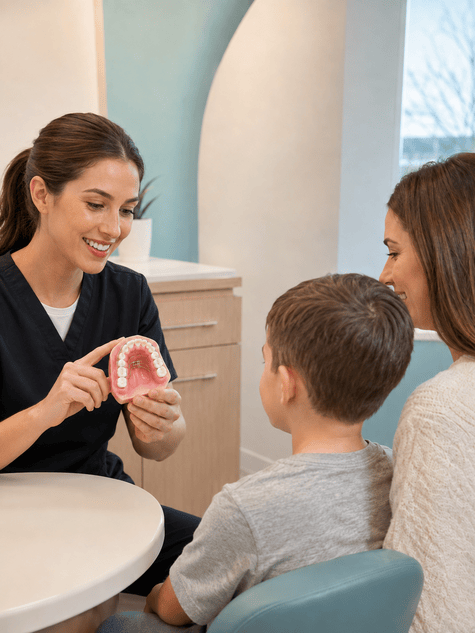

Oral Habits We Address With Habit Breaking Appliances
Habit breaking appliances at Springtown Pediatric Dentistry are designed to address the most common oral habits that can disrupt healthy dental development in children. Each habit works differently on the teeth and jaw, and the type of appliance recommended will depend on which habit is present and how long it has been occurring. These are the habits we most commonly treat.
If your child is struggling with any of these habits, an early evaluation at Springtown Pediatric Dentistry can help determine whether a habit breaking appliance is the right solution before lasting dental changes occur. Children who need sensory, developmental, behavioral, or communication accommodations can receive the same flexible approach used in our special needs pediatric dentistry services.
What Can Happen If These Habits Continue Untreated
Not every child who sucks a thumb or uses a pacifier develops a bite problem. The risk depends on how long, how often, and how strongly the habit occurs. When changes are already visible, ending the habit can help prevent them from progressing as permanent teeth begin to emerge.
The sooner these concerns are identified and addressed, the more treatment options are available and the less invasive those options tend to be.

Why Families Love Springtown Pediatric Dentistry
Habit-Breaking Appliance FAQs for Parents
Conveniently Located Near San Marcos, TX
Springtown Pediatric Dentistry is located at 310 Stagecoach Trail, Suite 1000, San Marcos, TX 78666. We welcome infants, children, teens, and children with special healthcare needs from San Marcos, Kyle, New Braunfels, Wimberley, Martindale, Maxwell, Uhland, Redwood, and Staples.
Whether your child is visiting for preventive care, a dental concern, or more involved treatment, Dr. Mueller and our team provide clear guidance and personalized care at every step. Our goal is to make each visit comfortable for children and reassuring for parents while supporting healthy smiles through every stage of growth.